Introductory price — today only

📄 Digital book in PDF: it comes by email. Nothing is shipped on paper.

Coding exam: the 5-step method from chart to code with one route you repeat on every chart

How to read the report, pull what counts, search the index, verify and choose, with your own code books open. It teaches the method; the codes stay in your books.

Get the book now ➤

🔒 Protected checkout · PDF by email · 30-day guarantee

60drawn pages, one topic each
5parts, from basics to exam day
2free bonus books included
PDFby email, ready to print

Take a look inside the book

Designed to read on your phone screen or printed next to your open code books at the desk.

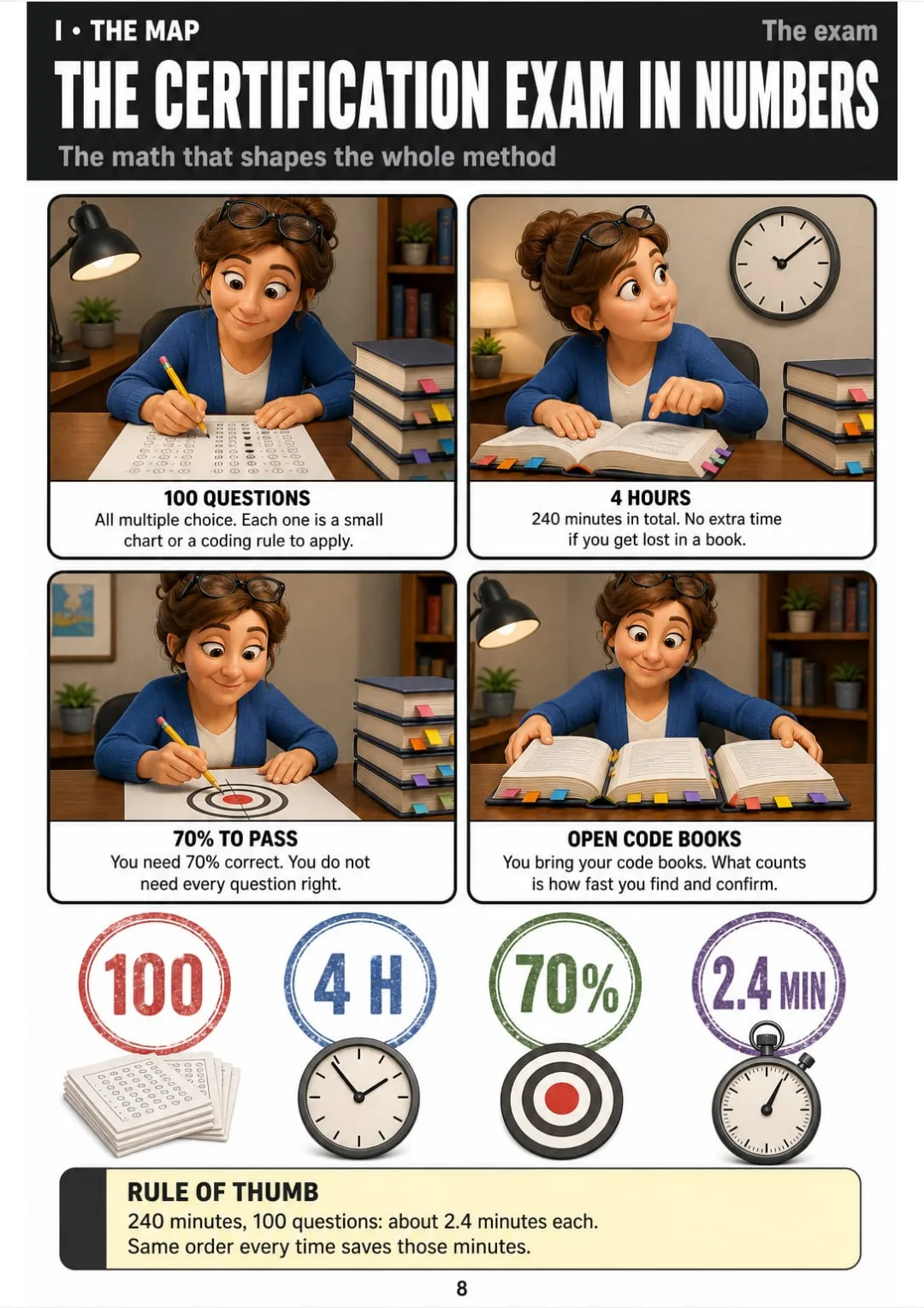
The exam: 100 questions, 4 hours, 70% to pass, open books, about 2.4 minutes per question.
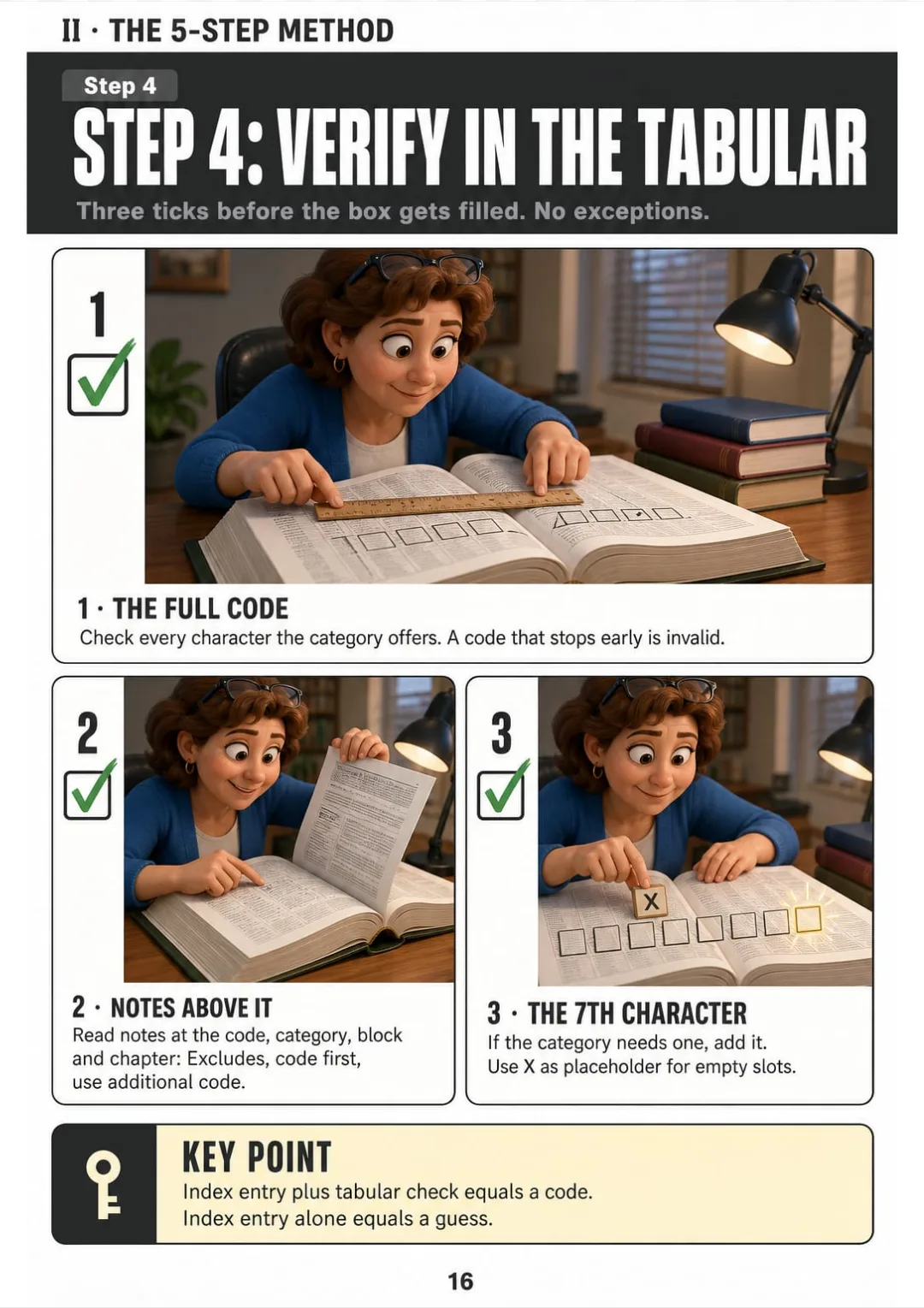
Step 4: full code, notes above it, 7th character. Three ticks, then write.
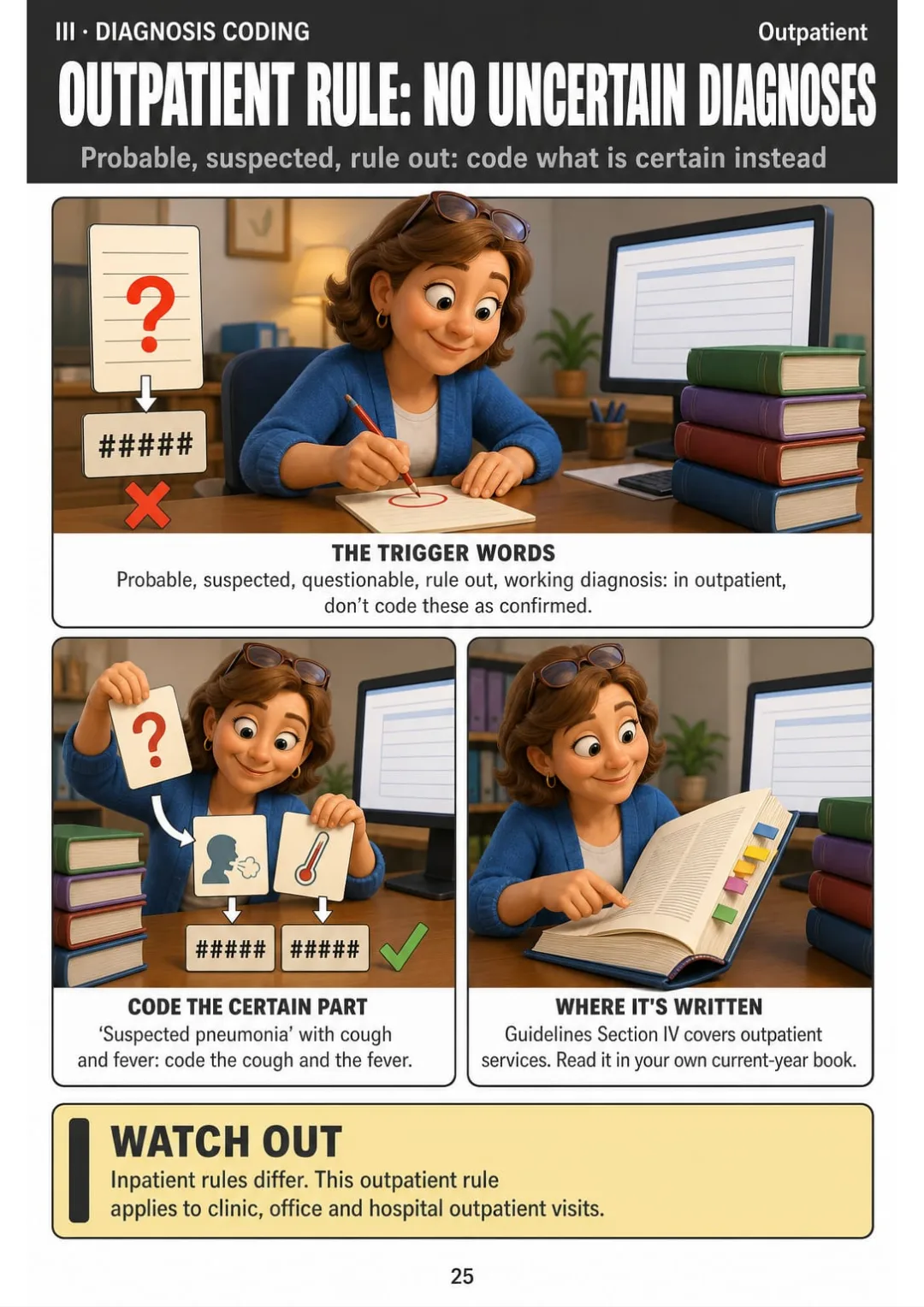
Outpatient: probable, suspected or rule out is never coded. Code the symptoms.
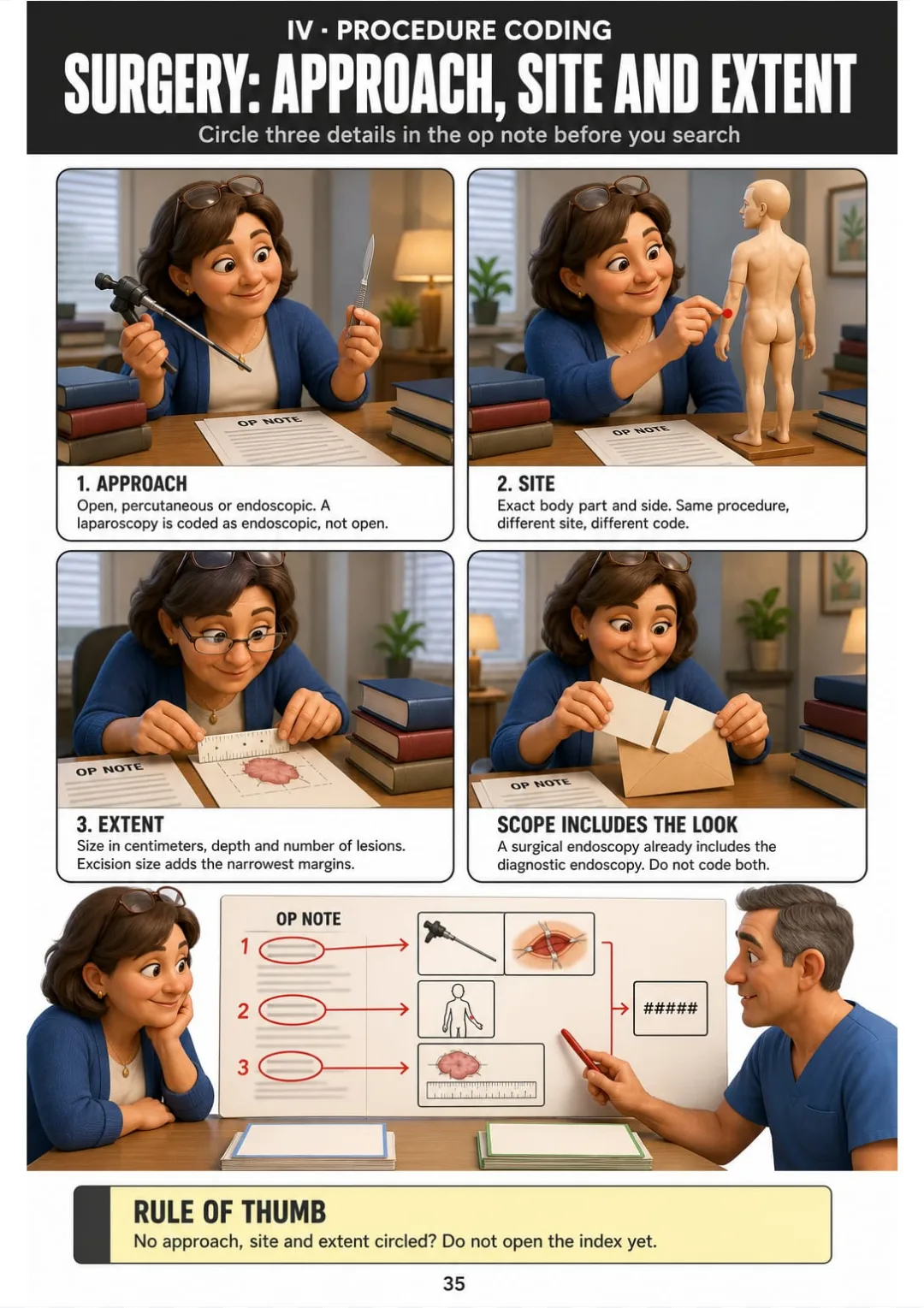
Before searching a surgery code, circle approach, body site and extent.
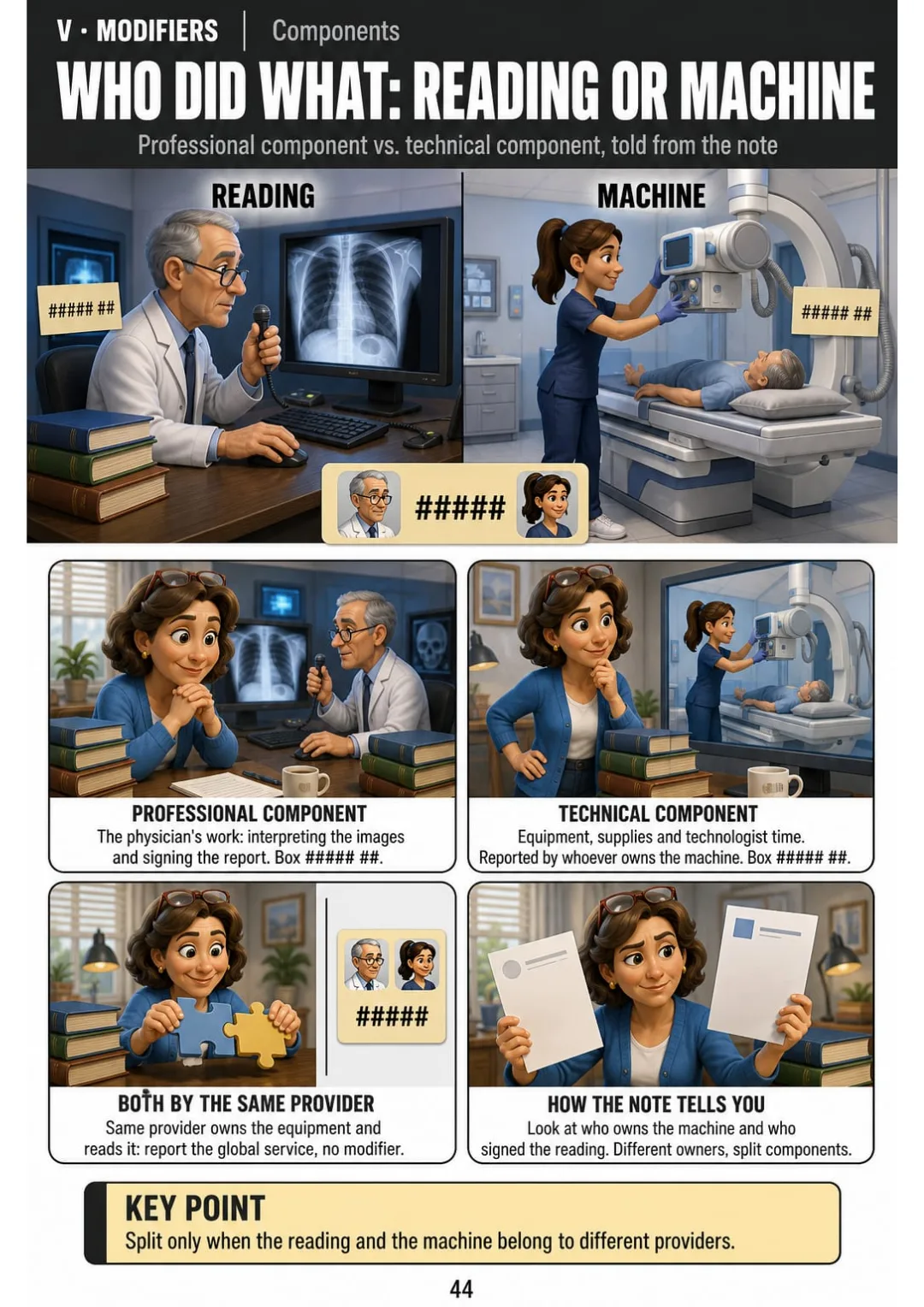
Reading vs. machine: professional and technical components, and when you report the global service with no modifier.
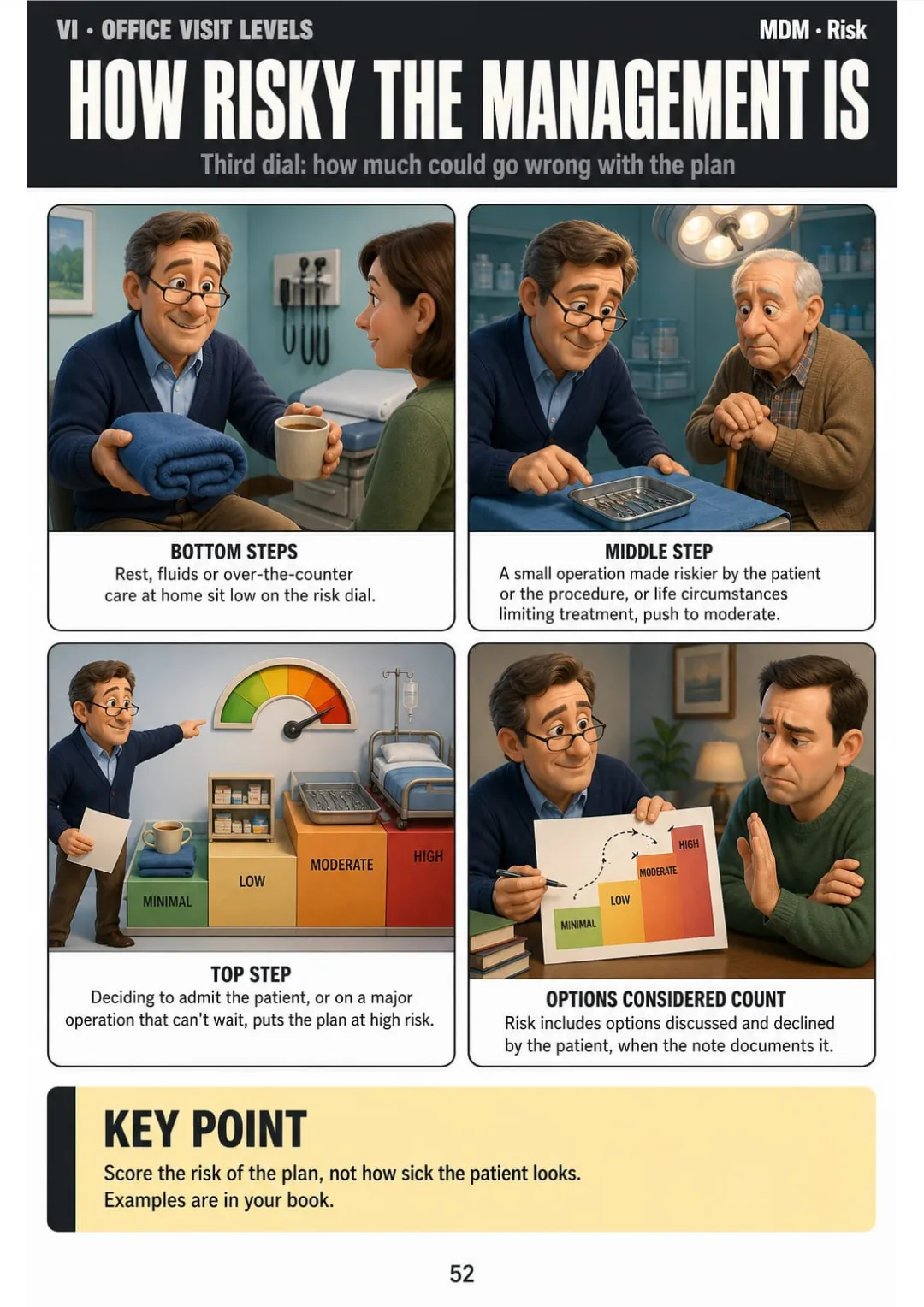
Risk of management: from rest at home to a decision about hospital admission.
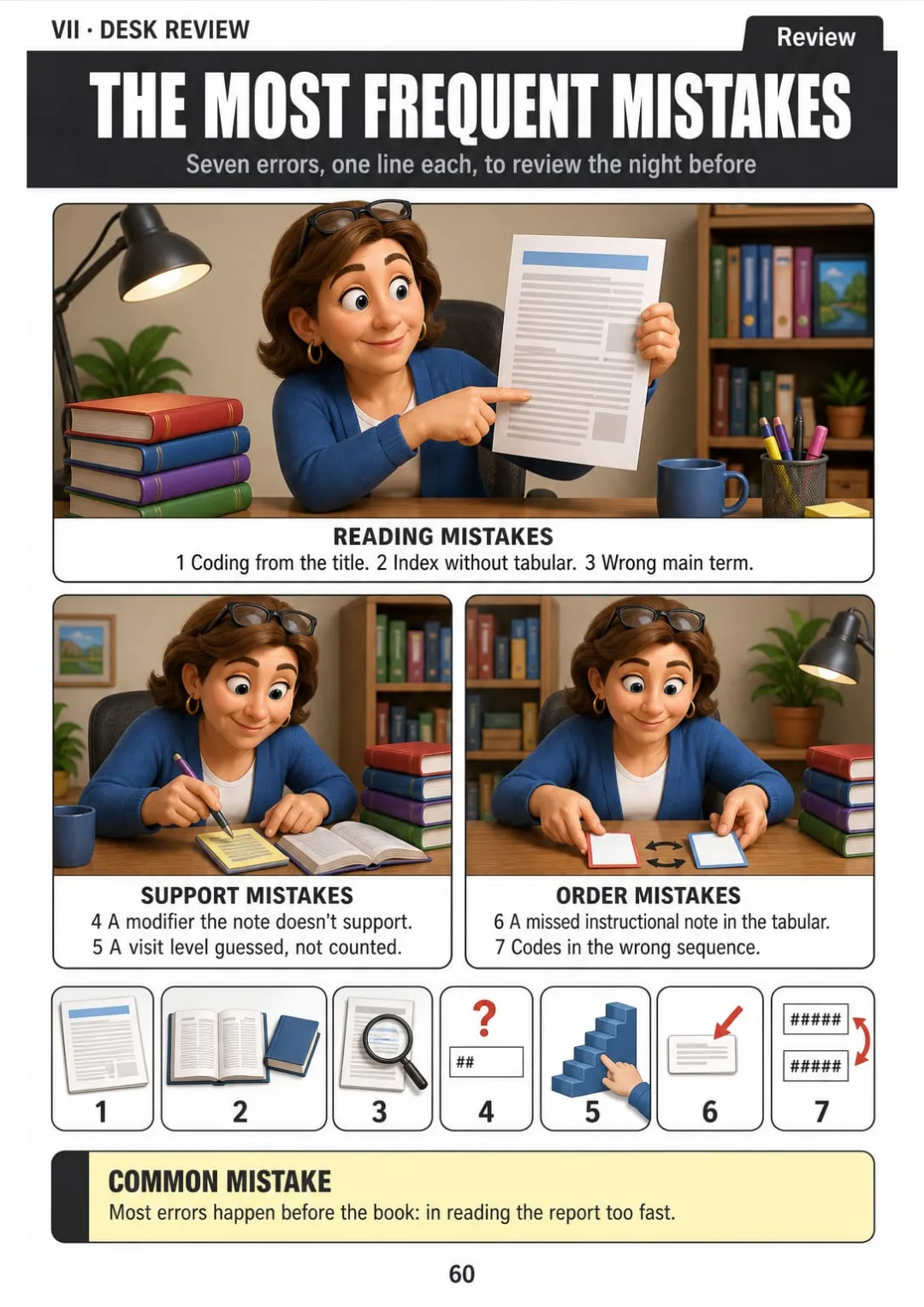
From coding from the title to wrong sequencing: the 7 most frequent mistakes.

Swipe to see more · tap to zoom →

Your code books aren’t the problem. Using them without a route is.

You worked through the same chapter twice. Back at the desk, two codes that differ by one character look identical.

You start a practice test and run out of time because you went back to the index three times for the same term.

Modifiers? Visit levels? You pick them by gut and hope for the best.

You code from the procedure title. The report body tells a different story. The claim comes back denied because the heading wasn’t the whole case.

Outpatient: probable, suspected or rule out is never coded. Code the symptoms.

Page sixteen: step four. The full code, the notes above it, the seventh character. Three checks before you write anything.

One page. One drawing. The step you used to skip becomes the step that catches your mistakes.

Step one: read the whole report, not the title. That single habit catches the mismatch before you open the index.

That’s what changes when you have a route.
COMPARE

The same topic, studied two ways

INSTEAD OF THIS
  • Read a dense paragraph about surgical code selection and try to remember three variables at once.
  • Highlight the textbook and hope the highlighted parts stick by exam day.
  • Watch a forty-minute video that covers five topics and take notes you won’t reread.
When assigning codes for surgical procedures, the coder must first ascertain the surgical approach employed by the physician—open, percutaneous, endoscopic, laparoscopic, or robotic-assisted—as documented in the operative report. The anatomical site must then be identified with specificity, including laterality where applicable. Finally, the extent of the intervention—whether partial, complete, or radical—must be determined by cross-referencing the procedural narrative against code descriptors, accounting for parenthetical instructions, inclusion and exclusion terms, and any add-on code designations to ensure accurate code selection.
CHOOSE THIS
  • Open one page: approach, body site and extent — circled and labeled in a drawing.
  • See the three variables at a glance. No highlighting needed, no rereading.
  • Review the page in thirty seconds before you open your code books.
Reading vs. machine: professional and technical components, and when you report the global service with no modifier.
CONTENTS

Take a look: 5 parts, 60 topics

Five parts: from how codes are built to exam day. The 5-step method, diagnosis rules, procedure coding, modifiers and visit levels — each topic on one drawn page.

IThe Map and the 5-Step Method · pp. 5-19
  1. Three code sets, three questions
  2. Your code books are your tools
  3. Index first, tabular always
  4. The certification exam in numbers
  5. How an ICD-10-CM code is built
  6. How a CPT code is built
  7. HCPCS Level II at a glance
  8. The 5 steps in one picture
  9. Step 1: read the whole report, not the title
  10. Step 2: pull what counts
  11. Step 3: find the main term
  12. Step 4: verify in the tabular
  13. Step 5: choose and sequence
  14. Specificity: the zoom lens
  15. One chart, all 5 steps start to finish
IIDiagnosis Coding: ICD-10-CM · pp. 20-29
  1. Reading the index: main terms and subterms
  2. Conventions: NEC and NOS
  3. Excludes1 vs. Excludes2
  4. Code first, use additional code, code also
  5. Signs and symptoms: when to code them
  6. Outpatient rule: no coding uncertain diagnoses
  7. Combination codes
  8. Laterality and the 7th character
  9. Sequelae: the late effect pair
  10. Z codes: when the reason is not a disease
IIIProcedure Coding: CPT and HCPCS · pp. 30-39
  1. The CPT index: four ways in
  2. Section guidelines come first
  3. CPT symbols you must spot
  4. Parent codes and indented codes
  5. The global surgical package
  6. Surgery: approach, site and extent
  7. Radiology: complete vs. limited, professional vs. technical
  8. Pathology and laboratory: panels and units
  9. Anesthesia: base units plus time
  10. HCPCS Level II: finding supplies and services
IVModifiers and Visit Levels · pp. 40-55
  1. What a modifier does and does not do
  2. A separate visit on a procedure day
  3. A distinct service the edits would bundle
  4. Several procedures in one session
  5. Who did what: the reading or the machine
  6. One side or both
  7. Repeat and return trips
  8. Visits inside the global period
  9. New or established patient
  10. Two ways to pick the level: MDM or time
  11. How many problems, how serious
  12. What the provider had to review
  13. How risky the management is
  14. The 2-of-3 rule
  15. Choosing by total time
  16. One visit note, leveled step by step
VExam Day and Desk Review · pp. 56-64
  1. 2.4 minutes per question: your pace card
  2. Rule out answers before you open the book
  3. Tab your books before the exam
  4. When to stop searching and move on
  5. The most frequent mistakes, one line each
  6. The 5 steps checklist to print
  7. Conventions cheat page
  8. Annual updates: why your books must be current
  9. Using the method at your desk

One topic per page. One drawing. That’s the format.

Each page shows one concept: one heading, one drawing, one idea to keep. No dense paragraphs, no three-column tables, no footnotes in size eight.

Risk of management: from rest at home to a decision about hospital admission.

Page forty-four: professional component, technical component, and when you report the global service with no modifier. One drawing shows what took a full paragraph in the manual.

See the page once, and you know where the rule lives.

What's inside Medical Coding, One Page at a Time

Ipp. 5-19

The Map and the 5-Step Method

Open the 5-step picture and know which check comes first, second and last — before you touch your code books. Page eight: the three numbers that set your exam-day pace.

IIpp. 20-29

Diagnosis Coding: ICD-10-CM

See one drawn page and stop second-guessing NEC vs. NOS, Excludes1 vs. Excludes2, or when a symptom gets its own code. The outpatient rule on one page.

IIIpp. 30-39

Procedure Coding: CPT and HCPCS

Four ways into the index, the global surgical package on one page, and how to read parent codes and indented codes without missing the one you need.

IVpp. 40-55

Modifiers and Visit Levels

A yes/no tree on one page settles whether you need a modifier — no guessing. Visit levels: count problems, check data, judge risk and pick the level in under a minute.

Vpp. 56-64

Exam Day and Desk Review

Your pace card: 2.4 minutes per question, when to stop searching and move on, and a print-ready checklist you take to the desk.

Plus, 2 free books come with it

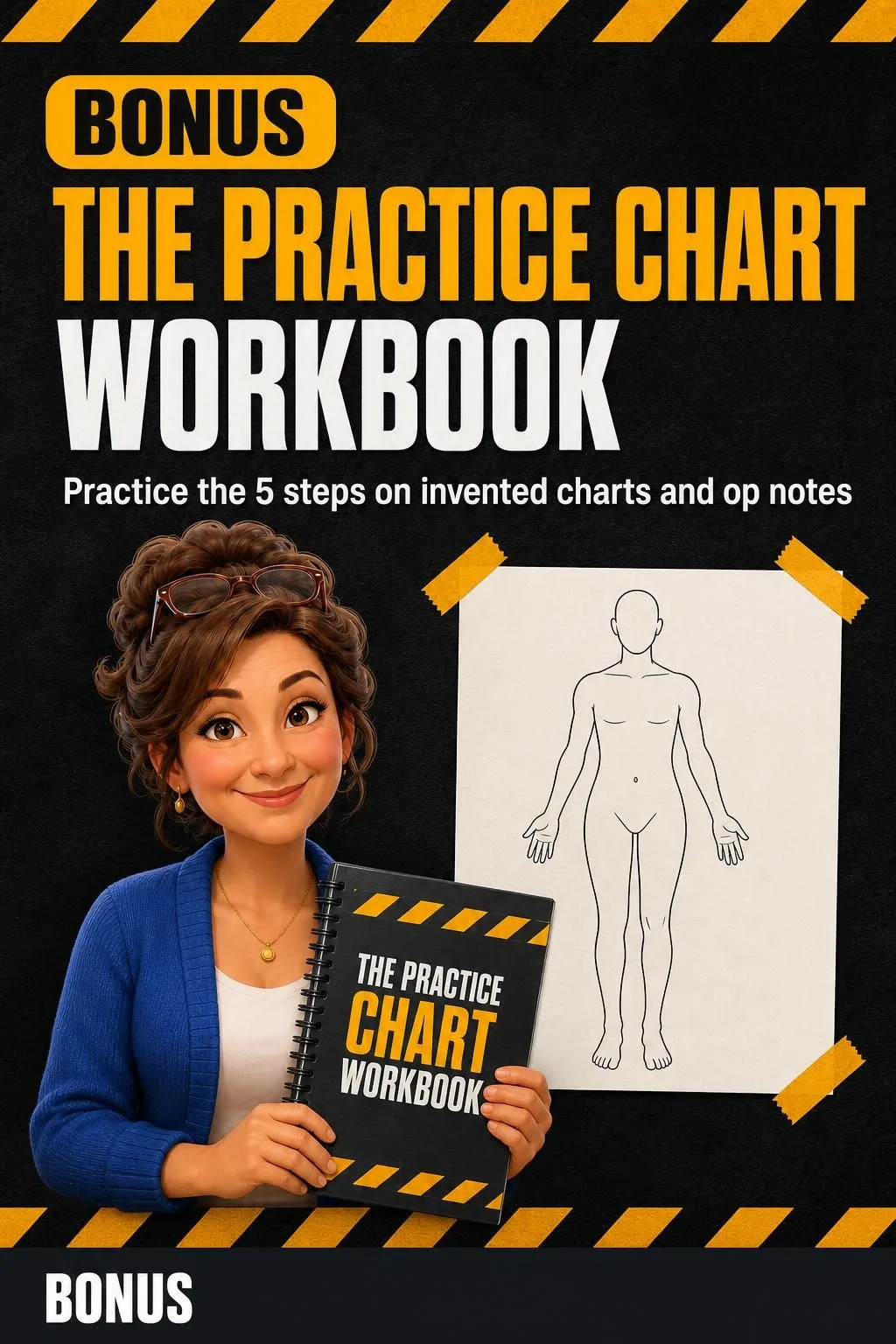
The Practice Chart Workbook

GIFT 1: «The Practice Chart Workbook»

Bought separately: US$ 17.90

Practice the 5 steps on invented charts and op notes until the order becomes automatic, with your own code books open.

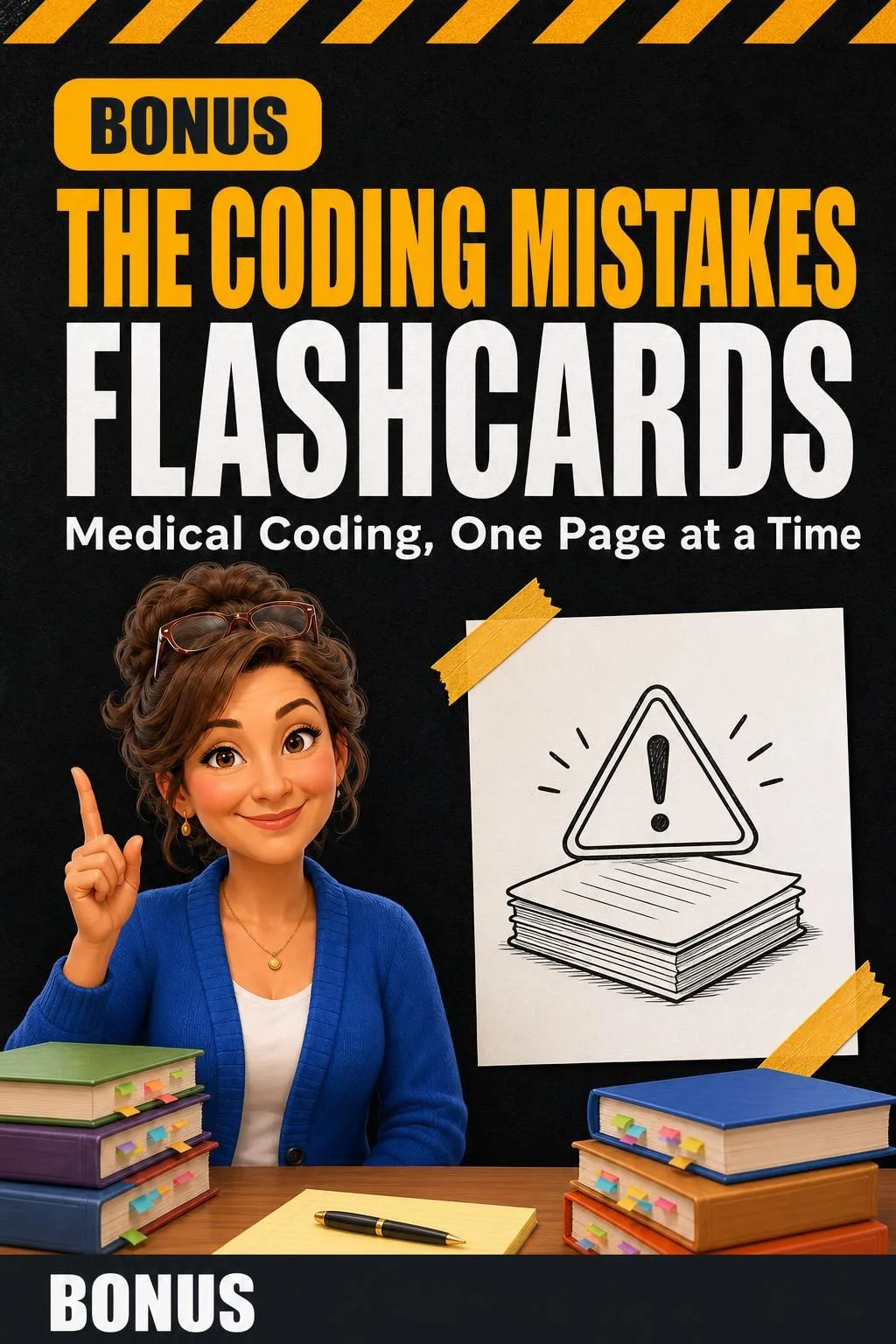
The Coding Mistakes Flashcards

GIFT 2: «The Coding Mistakes Flashcards»

Bought separately: US$ 14.90

Review the most frequent coding mistakes, one card each, so you catch them before you mark an answer.

Your bundle: Medical Coding, One Page at a Time and 2 gifts

  • Medical Coding, One Page at a Time: 60 illustrated pagesUS$ 63
  • GIFT 1: The Practice Chart WorkbookUS$ 17.90
  • GIFT 2: The Coding Mistakes FlashcardsUS$ 14.90
  • High-quality PDF file, ready to printIncluded
Total value US$ 95.80
BUNDLE PRICE
US$ 27
YOU SAVE: US$ 68.80
GET MEDICAL CODING, ONE PAGE AT A TIME · US$ 27

📄 Digital book in PDF: it comes by email. Nothing is shipped on paper.

Protected paymentEncrypted data30-day guarantee

PDF by email: You receive Medical Coding, One Page at a Time as a PDF in your inbox, along with the 2 free books. You pay once: no installments, no extra charges.

Who keeps this book at the desk?

Studying for the certification exam

Studying for the certification exam

You’ve been reading code books and watching videos for months, and you still can’t finish a practice test on time. This gives you a fixed route for every question.

Already coding at a desk

Already coding at a desk

You assign codes every day but pick the modifier or the visit level by gut. The yes/no trees replace guessing with a clear path you can explain.

Retaking the exam

Retaking the exam

You didn’t reach the passing score and you’re paying for another attempt. This book gives you the method you didn’t have the first time.

Everything your purchase includes

US$ 95.80US$ 27
GET MEDICAL CODING, ONE PAGE AT A TIME · US$ 27

📄 Digital book in PDF: it comes by email. Nothing is shipped on paper.

30DAYS
GUARANTEE

30 days to try it

30-day 100 % money-back guarantee. Try it with your code books open. If it doesn’t give you a clear route from chart to code, tell us what didn’t work and we’ll refund every cent.

Common questions

Is this a physical book or a digital file?

It’s a PDF file sent to your email. You can read it on any screen or print it and keep it next to your code books.

Can I read it on my phone?

Yes. Every page is designed for a phone screen — one topic, one drawing, no tiny text.

Does it include actual codes?

No. It teaches the method: how to read the chart, find the main term, verify in the tabular and choose. You look up every code in your own current-year code books, so the method still works when the codes change each year.

Does it work for my exam?

Yes, if you’re preparing for a U.S. outpatient coding certification exam such as the CPC®, or already coding in the U.S. It works with the three code sets those exams use: ICD-10-CM, CPT® and HCPCS Level II. The rules are checked against the ICD-10-CM Official Guidelines for Coding and Reporting and the guidelines printed in your own code books. It is not official prep from any certification body, it does not give you a certificate and it cannot promise you will pass. The exam format (100 questions, 4 hours, 70 % to pass) is sourced from AAPC.

I’m starting from zero. Is it too advanced?

Each topic starts from scratch, one page at a time. No prior coding experience is needed.

Do I get a certificate or CEUs?

No. It’s a study book, not a course: no certificate, no CEUs, no exam voucher. You get the PDF by email at the address you enter at checkout, and you can print it.

Is it a one-time payment?

Yes. One payment, no subscription, no recurring charges.

Does it replace a coding course?

No. Think of it as a drawn companion to your coursework and your own code books. Formal training and supervised practice still come first.

Before you close this page

No more freezing in front of the chart.

No more guessing the modifier and hoping it sticks.

Open the page, follow the steps, pick the code.

You already own the code books. What they don’t give you is a route through them: five steps, repeated on every chart.

US$ 27, paid once · 30-day guarantee · PDF by email

GET MEDICAL CODING, ONE PAGE AT A TIME · US$ 27

📄 Digital book in PDF: it comes by email. Nothing is shipped on paper.